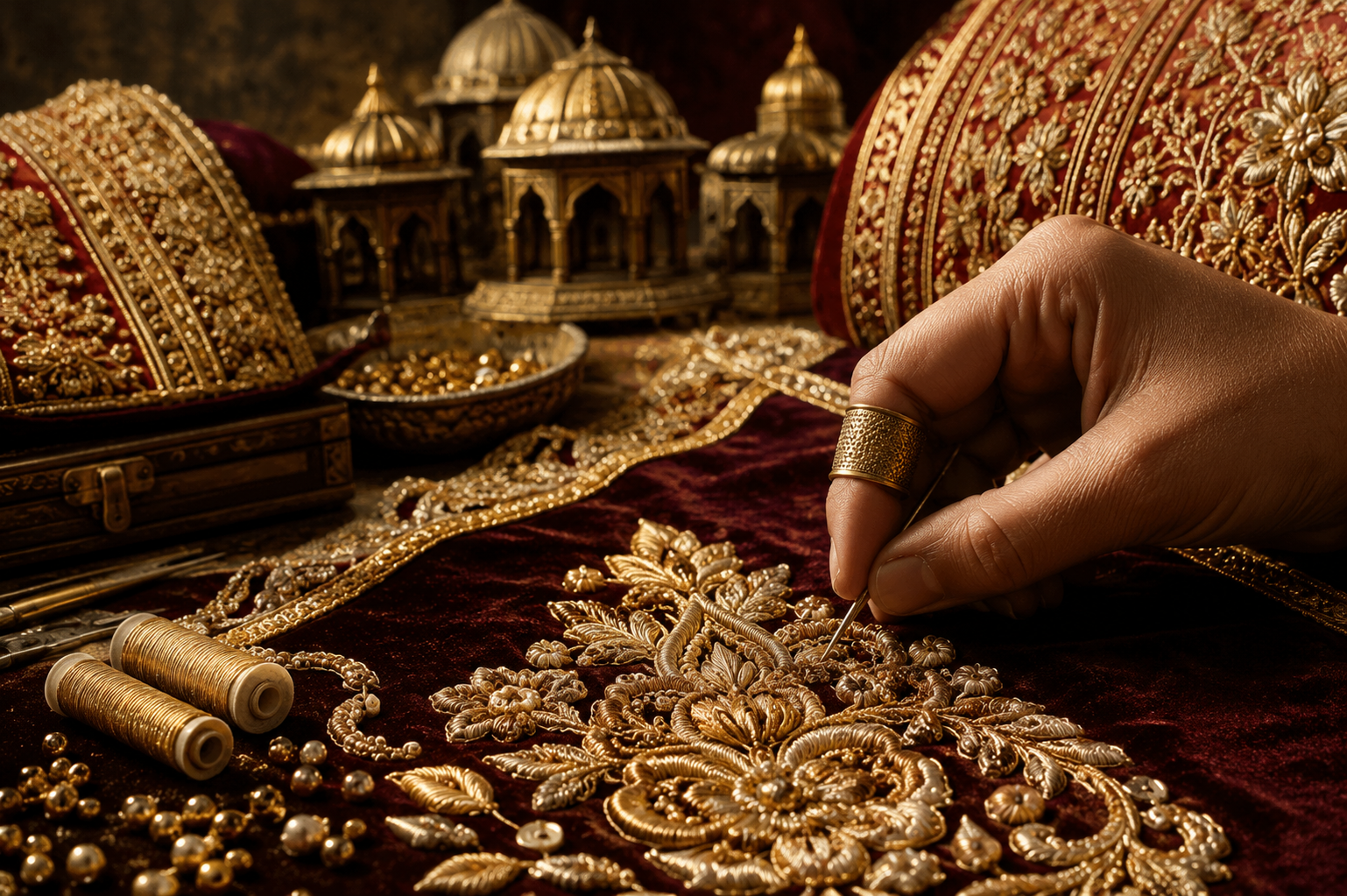
The Rich Heritage of Zardozi
Zardozi embroidery is one of the world’s most exquisite forms of hand embroidery, celebrated for its intricate craftsmanship, luxurious appearance, and timeless elegance. The word “Zardozi” is derived from two Persian words — “Zar”, meaning gold, and “Dozi”, meaning embroidery or sewing. True to its name, Zardozi is a magnificent embroidery technique that traditionally uses gold and silver metallic threads to create elaborate patterns on rich fabrics such as silk, velvet, satin, and brocade.
Through the Centuries
The Journey of Zardozi
Medieval Period
Introduced by Persian & Afghan Artisans
The art of Zardozi was introduced to the Indian subcontinent by Persian and Afghan artisans, bringing centuries of technique with them.
16th – 17th Century
Flourished Under the Mughal Empire
Zardozi flourished under the patronage of the Mughal Empire, as emperors and royal families adorned their garments, turbans, ceremonial robes, wall hangings, and palace décor with exquisite Zardozi work — a symbol of royalty, luxury, prestige, and fine craftsmanship.
1714
Farrukhabad Founded
Farrukhabad was established by Nawab Muhammad Khan Bangash and named after the Mughal Emperor Farrukhsiyar. Located on the banks of the holy River Ganges in Uttar Pradesh, the city gradually evolved into one of India’s most renowned centres for Zardozi Embroidery and Aari Work.
Present Day
Farrukhabad — The Heart of Zardozi Embroidery
Over generations, skilled artisans in Farrukhabad perfected this intricate craft, earning the city international recognition for producing some of the finest handcrafted bridal embroidery, designer lehengas, luxury sarees, and couture embellishments. Today, Farrukhabad is proudly known as one of India’s leading hubs for Zardozi, Aari, Resham, Dabka, Nakshi, Pearl Work, Sequin Work, and Hand Embroidery.
Materials & Technique
The Art Behind Every Stitch
Traditional Zardozi embroidery is meticulously handcrafted using a combination of:
Gold & Silver Metallic Threads (Zari), Dabka, Nakshi, Salma, Sitara (Sequins), Pearls, Beads, Stones & Crystals, Resham Threads, Aari Needle Work.
Each masterpiece requires exceptional skill, patience, and precision, with many bridal outfits taking several weeks or even months to complete.
Timeless, Reimagined
Zardozi in Modern Fashion
While rooted in centuries-old traditions, Zardozi continues to be one of the most sought-after embroidery techniques in luxury fashion. Today, it is widely used in:
Bridal Lehengas, Designer Sarees, Bridal Anarkalis, Embroidered Salwar Kameez, Luxury Gowns, Sherwanis, Dupattas Couture Dresses, Boutique & Designer Collections.
Its unmatched elegance makes it a preferred choice for weddings, festive occasions, fashion designers, couture labels, and luxury boutiques across the world.
“For us, Zardozi is more than embroidery — it is a legacy woven with history, artistry, and generations of craftsmanship that transforms every bridal creation into a timeless heirloom.”
Our Commitment
Preserving a Timeless Tradition
At VelVet Embroidery, we proudly carry forward the rich heritage of Farrukhabad’s renowned Zardozi and Aari craftsmanship. Since 1998, our skilled artisans have been preserving this centuries-old art by blending traditional techniques with contemporary bridal fashion.
Every handcrafted creation reflects our passion for quality, heritage, and timeless elegance, allowing clients across India, Canada, the USA, the United Kingdom, the UAE, and other international markets to experience the beauty of authentic Farrukhabad Zardozi Embroidery.